

St Mary Garden City
I first became acquainted with St Mary Garden City in 1986, when Dr Isaac Fanous took Monica and I to the church for a special visit to show us the icons he had been doing here since the beginning of the 1980s, some of which I had helped him prepare and had watched him paint in the atelier. A little later, in 1987, he asked me to paint a triptych icon of the Crucifixion for St Mary’s Dekat-El-Salabôt under his supervision (a wooden stand with icons of scenes of the Crucifixion, only used on Good Friday). I was pleased to see this triptych is still being used every year and is still as fresh as the day I finished it.
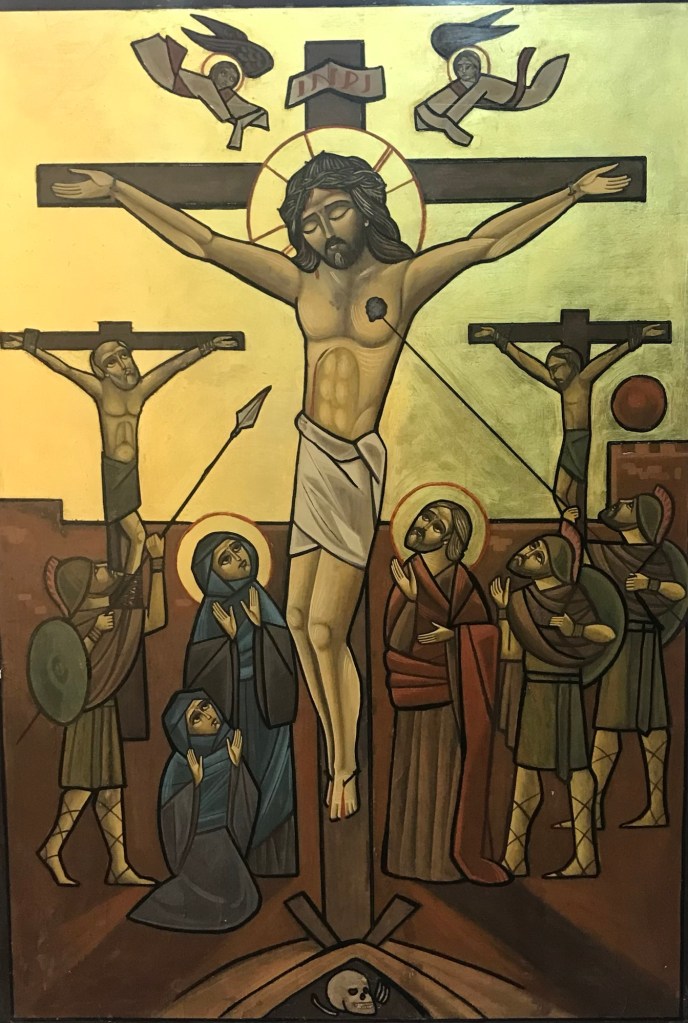
The 1980s were an important decade for Isaac Fanous, who saw his work output grow
exponentially and internationally. Although already well-known in Egypt and with a growing reputation in the Diaspora since the early 1970’s, the 80s saw his work undergo a subtle but significant stylistic evolution, exemplified at St Mary Ard El Gulf, Heliopolis or Sts Peter and Paul in Tanta, among many others.
St Mary Garden City’s icons form an invaluable collection of master pieces by one of -if not- the greatest Coptic artist of all time. In my humble opinion, St Mary’s icon collection encapsulates a crucial phase in the development of the contemporary Coptic style, or as I like to call it, the “Fanoussian” style.

The Iconography of St Merkurios Abu Sifain

As above mentioned, my relationship with this church started in the mid 1980s as a student and if someone had told me then that I would be doing this work some 37 years later, I probably would have joked it off.
The project seemed at first impossible and some logistic problems had to be solved, such as which indispensable materials were or weren’t available in Egypt. But all obstacles were eventually removed and we arrived in Cairo on 2 July 2023. This was my first visit to Egypt in 33 years.
Our first impression of the site was very positive. Although still unfinished, I was very pleased with the overall feel of the place, the proportions of the domes and apses, the use of noble materials like rough and smooth marble contrasting with wooden panels adorned with simple Coptic cruciform geometry and lattice panels (musharabiya). Subtle touches like the hidden lighting behind the frame of the three apses, I had never seen used before in a church building. The designer Sherif Morgan, clearly understands the effects of lighting in creating an atmosphere conducive to prayer and worship, as well as enhancing the iconography. Our brief was to create the iconography for 3 apses and 3 domes as phase 1 of the project. Phase 2 would be the iconostasis and phase 3, 8 icons around the nave. All works were executed in the traditional egg tempera technique or secco.
Concerning the 3 apses the chosen subjects are as follows:
Christ in Glory Pantocrator in the central apse.
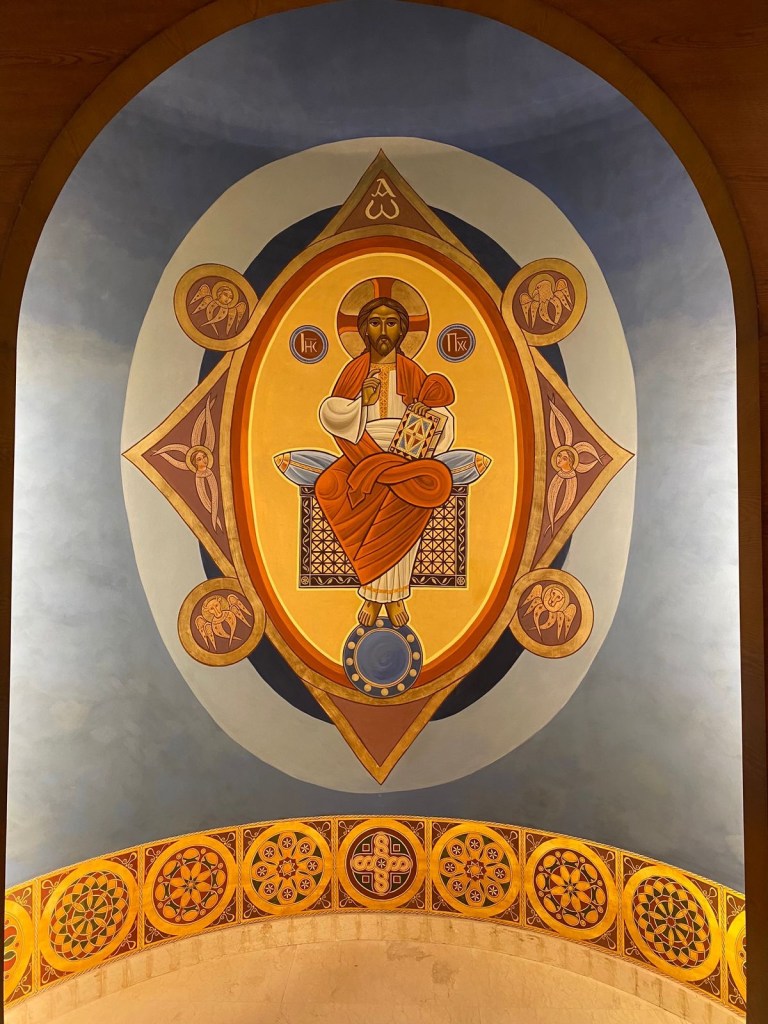
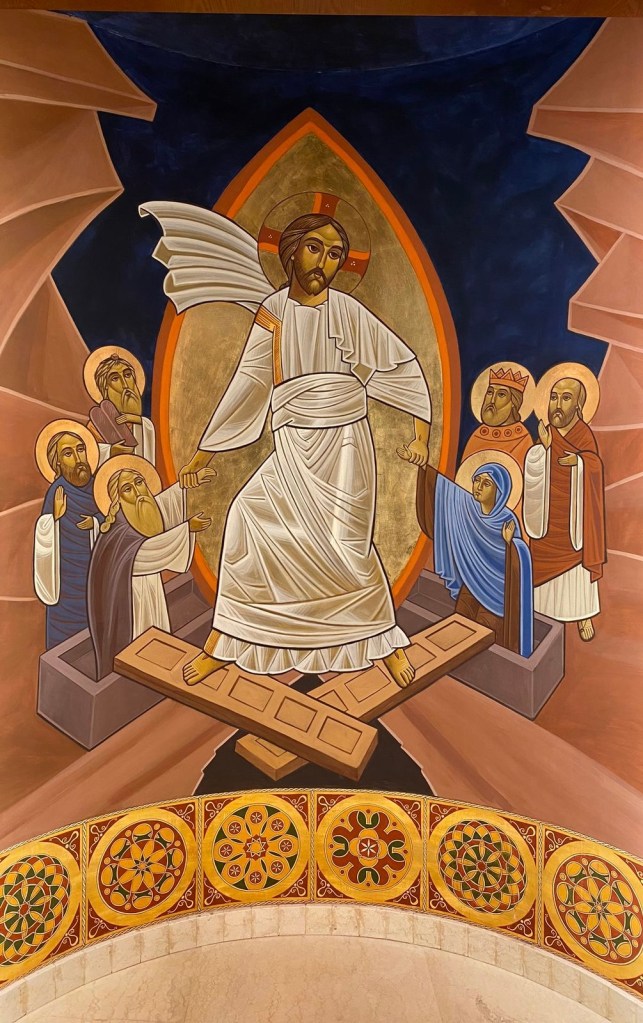
In the right hand apse is the Transfiguration and the Anastasis (Descent into Hades) in the left.
These 2 side subjects were chosen as they are pivotal moments in the story of salvation. The
Transfiguration is the icon of light par excellence and represents theosis or spiritualisation of matter, when heaven and earth are united. The transfigured Christ is flanked by Moses who stands for the law and Elijah who represents the prophets. Peter, John and James, depicted below, are blinded by the divine light and shield their eyes with their hands. Though they are not transfigured themselves, they nevertheless bathe in the uncreated light emanating from the Christ and are made witnesses of the event.

The other apse contains the Anastasis, which means Resurrection in Greek. It is also sometimes called Descent into Hades or the Harrowing of Hell. It depicts Christ raising the righteous from the dead and liberating those who had been waiting in the grave for His coming. With His right hand He raises Adam and with His left, Eve. He stands on the broken gates of hell that have fallen down in the shape of the cross. Old Testament figures are featured in the icon to strengthen the narrative. Their number can vary according to the space available. Christ is the main protagonist in the icons of His life’s events and is therefore always the largest figure in the composition. It should be noted that the Descent into Hades takes place while His body lays in the grave just after the Crucifixion and therefore takes place outside the body in the non-physical realms outside of time and space.
The domes
The subjects of the 3 domes were discussed at length with Bishop Rofail, whose diocese includes St Mary’s, because the subjects I proposed were a little unusual in modern Coptic Churches. For the central dome, right above the altar, I proposed the icon of the Virgin of the Sign, according to Isaiah 7:14 and also Matthew 1:23 :”Behold, a virgin shall be with child and shall bear a Son, and they shall call his name Immanuel”. This subject is not foreign to Coptic iconography by any means and there are historical precedents.
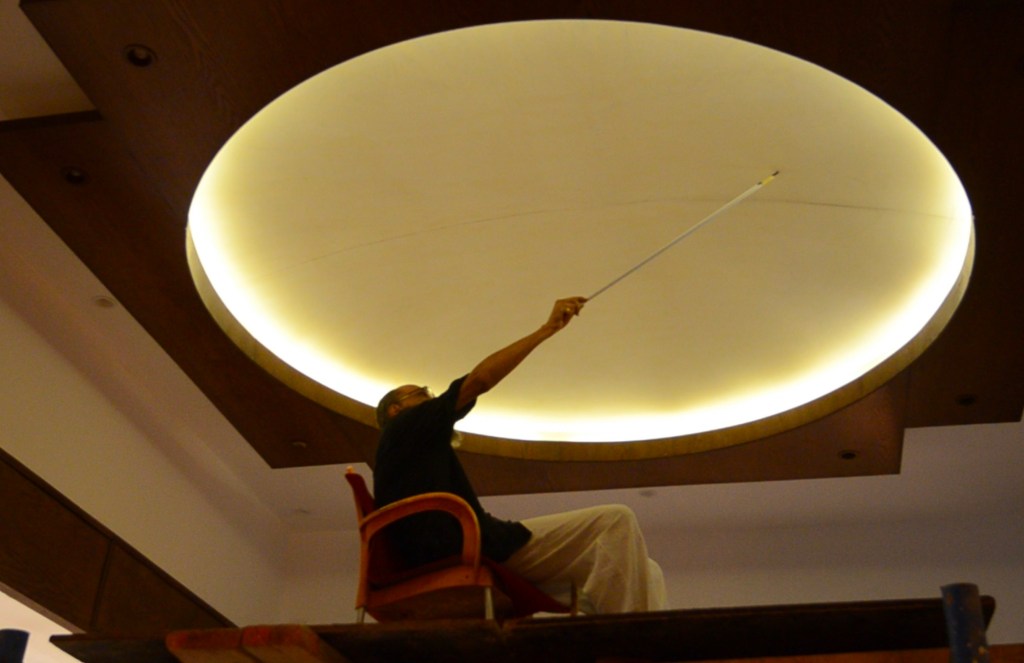


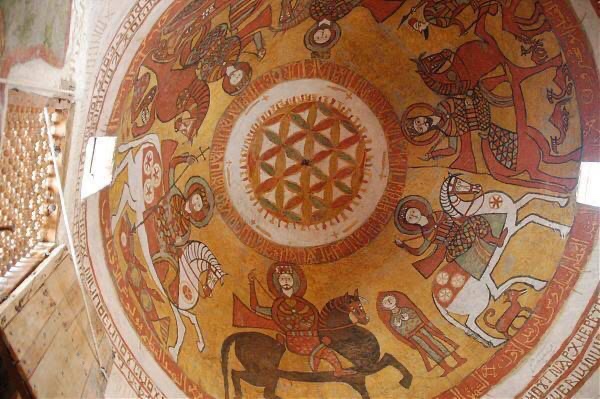
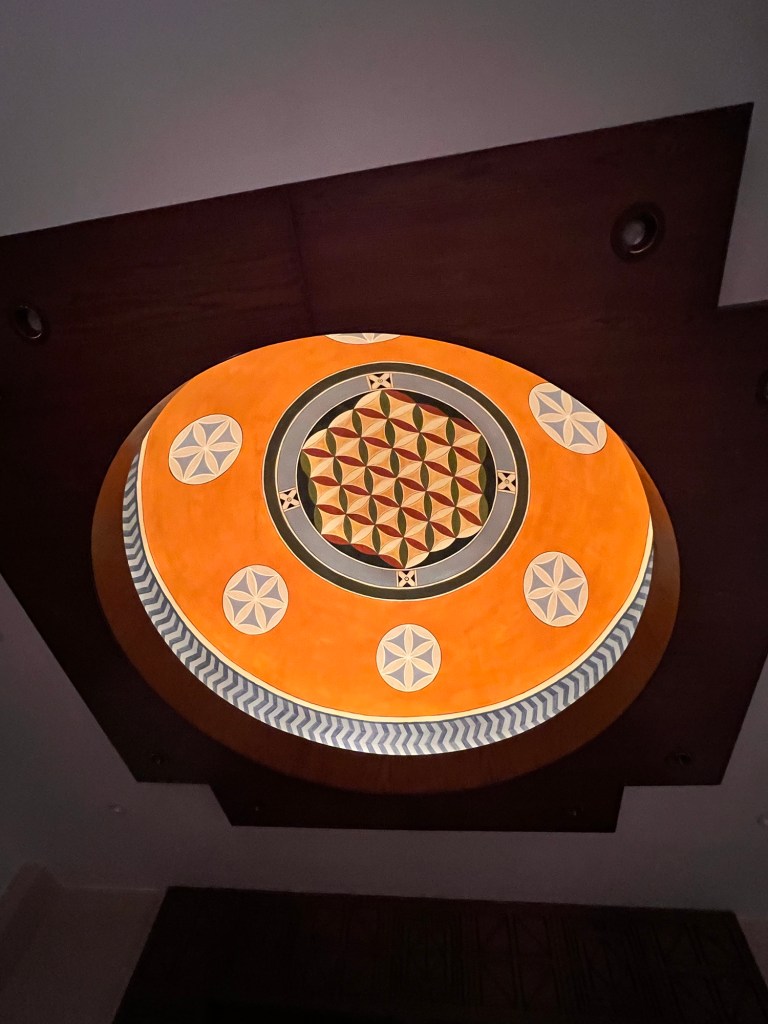
The 2 side domes contain 2 versions of the Primary Pattern also commonly known as the Tree of Life. The Primary Pattern is a very interesting subject that will be discussed in another post, as it really deserves a dedicated blog entry. It suffices to say that although it is found in numerous ancient cultures, it is particularly true in the case of both Ancient Egyptian and Coptic cultures. The idea of using the Primary Pattern was inspired by the famous dome of St Paul of Thebes Monastery in the Red Sea Desert.
The domes were designed and executed under my supervision by Calum Rees Gildea, including the several geometric panels bordering the lower register of the apses.


I thank God for the opportunity of doing this work. I also wish to thank my 2 brilliant assistants Daniel Wild Corbett and Calum Rees-Gildea for their support and dedication, as well as all the wonderful people of the congregation of St Mary’s Garden City and last but not least, H.H. Pope Tawadros II and H.G. Bishop Rofael for their enthusiastic support in the project.
Photographs by Daniel Wild Corbett
 Coptic Iconography
Dear Stephane,Thank you for sharing this wonderful work with me and others.It is absolutely brilliant and very inspirational.Meanwhile, we do hope you are keeping well and that maybe we will see you again if you ever come to Somerset/Dorset Very best wishes,Sarah Jane Sarah Jane Lewissjanelewis@yahoo.co.ukM:07817624935
LikeLike
Dear Sarah Jane,
Thank you for your kind message. Until we meet again. With best wishes to you both
LikeLike
Completely brilliant and inspirational. Thank you Stephane and assistants.
LikeLike