
It’s been a while since I had a good rant. I hesitated for a while to publish this post, which I started writing months ago, preferring to focus on my work and not get involved in what I have come to think of as the Coptic iconographic swamp. But when I open Instagram and see the stuff in my feed calling itself Coptic iconography, I’m never quite sure whether to laugh or cry, perhaps both. I felt I should at least comment on the situation. There appears to be no one willing or educated enough in the subject to speak up. I guess it is incumbent upon me as a senior practitioner to say something about it. In doing so, I will probably repeat things I have already said in previous posts and if so, I apologise in advance. I may also inadvertently tread on toes, for which I do not apologise.
The title of this post refers to one of Prof Isaac Fanous’s favourite sayings to describe what was already happening back in the early 1980s, albeit in a much milder and contained form than today. The advent of social media is in my opinion largely responsible for the proliferation of bad iconography today and especially so in the case of Coptic iconography. Another applicable quote would be the biblical reference to “the blind leading the blind” as found in chapter 15 of St Matthew’s Gospel. This quote does rather accurately describe those who teach what they themselves don’t know. Those individuals (described as “charlatans” by Isaac Fanous) are by definition false teachers who pretend to know something they don’t, perhaps for financial gain, social position or personal advancement. In the Coptic Church today anyone can self proclaim to be an iconographer, using social media to promote themselves and advertise workshops and courses without ever had any training or tuition themselves whatsoever or learned what they think they know from another just like themselves. This perpetrates the cycle of ignorance and bad practice. But has anyone noticed anything? It would appear not.
I do hope I’m wrong, but it would seem the next upcoming new trend after iPad icons is AI icons, if it’s not already here. Every other day a new social media page is created displaying childish doodles masquerading as Coptic iconography. Those who consider themselves accomplished iconographers with many large projects, are the worst of all and with the biggest egos. I will not call any specific names here, my aim is not to offend or shame anyone, but I’m sure they will know who they are. They should know better, but they don’t. Why? How could they know what they were not taught? The next question is: why were they not taught? Because since the passing of Isaac Fanous, there has been nowhere to learn anything, it’s as simple as that. As long as there is no proper centre of learning, Coptic iconography will continue to drift according to the “creative whims” of self-appointed iconographers, mostly trained (if at all) as illustrators, graphic designers and such like. Same for those who did a BA or MA in a contemporary Western art institution. IMHO, one of the main issues is that iconography is mostly seen as a job and a way to make a living now, not something one would be prepared to study for some years before practising it or teach it. That is surely the worst possible mentality for doing such work. It is worth repeating as often as necessary that iconography is not and should not be regarded as a job or a career move, but as a vocation. To be clear, the word comes from the Latin vocatio “a call”, an occupation to which a person is especially drawn or for which they are suited, trained or qualified. Though now often used in non-religious contexts, the meanings of the term originated in Christianity. I think it is fair to say that Coptic iconography has been de-sacralised and brought down to the level of art for art sake, mere decoration, a channel for self expression, a commodity, subject to fads and fashions and thus drained of any meaning or transcendence. For the few with some artistic talent who may have studied contemporary secular painting, their work unfortunately is at best an exercise in pure aesthetics, mainly focussed on “creating” new designs and styles, and at worst caricatures or doodles with biblical references.
Ego however remains the number one enemy of the iconographer and since it is totally unchecked in contemporary culture and even encouraged by parents and clergy alike, the problem starts very young and as the old adage goes, you cannot bend a tree when it has reached maturity, but when it is young and tender.
I think it is necessary here to make a distinction between sacred and secular art, as this distinction is not grasped by those who presume to be Coptic iconographers today. Some even go as far as saying there is no difference between the two. Perhaps this is true in other traditions, but not in the Coptic tradition that has a specific ritual concerning icons and sacred vessels which are consecrated as liturgical objects. Moreover, sacred or liturgical art is based on specific precepts, also called canon, and represents the very foundation of any school of iconography, ancient or contemporary. No canon, no icon. The canon is responsible for the homogeneity and coherence of all sacred art, whether it be christian or otherwise, including pre-Christian cultures/civilisations. All sacred art is subject to this yoke of the canon in order to ensure the optimal transmission of the tradition from which it emanates, upon which it is based and which it visually expresses. These criteria are to a large extent what makes a artefact sacred. To put it simply, the synthesis of faith, sacred text and iconography is only possible through the canon acting as the “interface” so to speak, between essence and form, spirit and matter, providing the visual grammar and symbolic vocabulary used to express sacredness and depict holiness in form.
On the other hand, modern secular art does not follow any canon whatsoever, in fact it purposely disregards any rules or the artist can make up their own as they go along. Although modern art may have a certain amount of theory developed by individual artists and art critics to provide some kind of explanation for doing what they do, but not always. Contemporary secular art in popular culture and as taught in schools and art colleges around the world, is based almost solely on self-expression.
Tradition (with a capital T) however, is not in the least concerned with self-expression or the need for novelty to renew itself, as secular art does. Neither does it have any regard for the individuality of the artist, who’s only seen as a channel. Because secular art follows no tradition and has no rules, anything and everything is allowed. One of the most extreme instances of this secular/sacred dichotomy can be seen in Canterbury Cathedral in the UK, where street graffiti has been sprayed on its ancient walls with the blessings of the Archbishop, to “celebrate” street art and popular culture. How cool is that! Fortunately the issue is of a different nature in the Coptic Church, but with no less negative effects.
These are just a few crucial differences between sacred and secular art and perhaps this subject could be developed further in a future post.
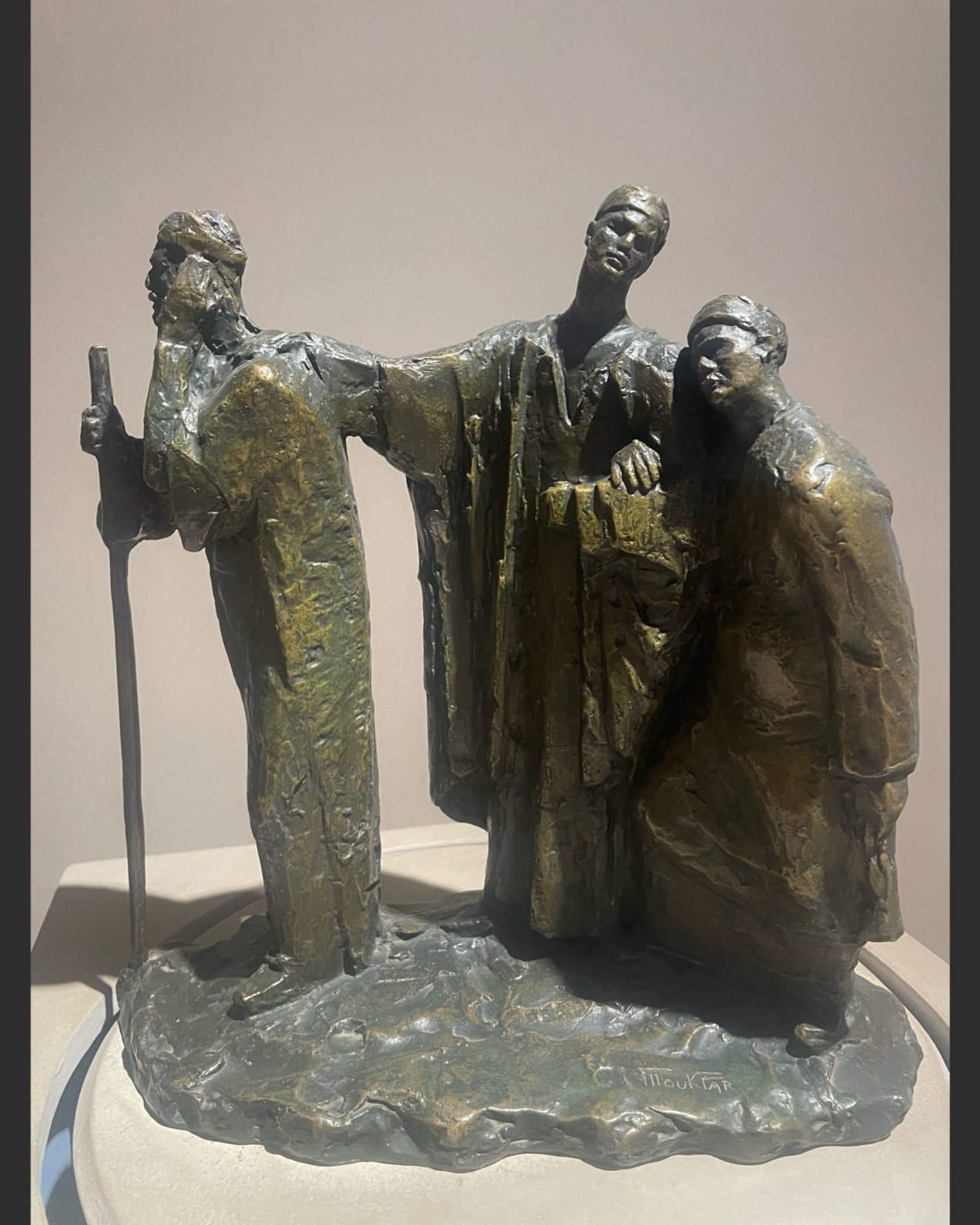
Image: the Blind leading the blind by Mahmoud Mokhtar (courtesy of the Mahmoud Mokhtar Museum, Cairo)


I think that love, encouragement, and open dialogue are what would make young iconographers want to follow a teacher, none of which feel present in the tone of this article. appreciating your frustrations, I don’t know that mocking young iconographers with sarcasm and all but calling them out by name will ever solve the problems you’re describing so it begs the question- what is the intention behind a post like this? Is it to teach or to scold? not an iconographer or artist at all myself, just found this post a little hard to read.
LikeLike
Thanks for your comment. This post is aimed at a very specific audience. I’ve tried the encouragement and dialogue approach before, it doesn’t work.
LikeLike
Hey Brother,
I know a lot has happened since i first started trying to pressure you into it… But you had eventually entertained the idea.
Are you still considering creating a “Dictionary” of sorts, so we can understand and read the Icons properly? I know this post is largely against digital creation, but there is also content issues and that is my biggest interest i want to learn. I pray you are well and hope you can visit us in Maine next time you’re in the States!
LikeLike
Yahoo Mail: Search, Organize, Conquer
LikeLike
Hello, I am a Coptic icon artist, and I would like to further my education and learn more.
Yahoo Mail: Search, Organize, Conquer
LikeLike
Dear Stephane,I think this is wonderful. Please keep in contact and visit us next time you are in the south west UKSarah x Sarah Sudlowsjanelewis@yahoo.co.ukM:07817624935
LikeLiked by 1 person